
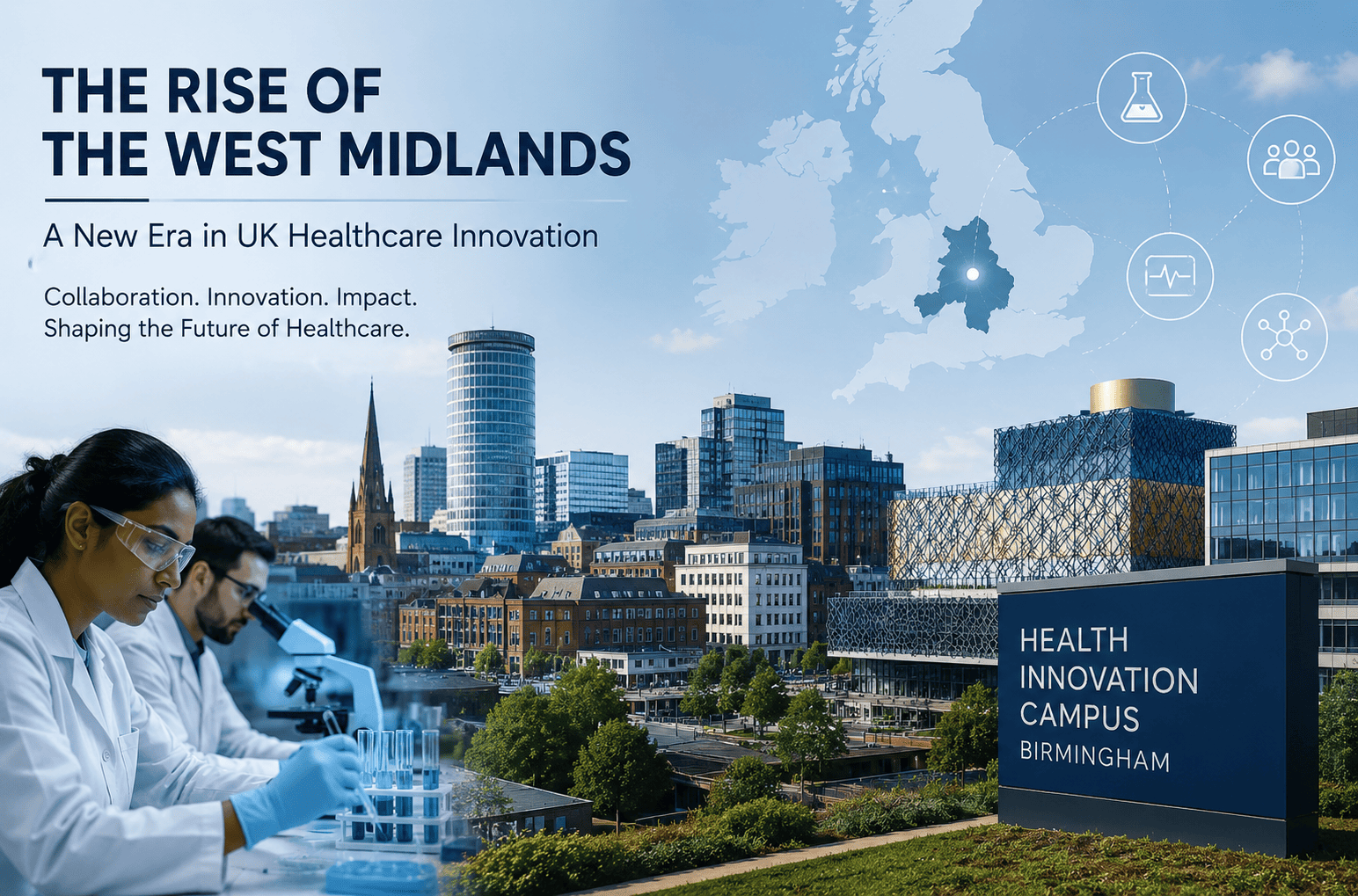
For decades, the narrative surrounding UK healthcare and scientific innovation has been dominated by a single unspoken rule: to build the future of medicine, one had to operate within the confines of the Golden Triangle, London, Oxford, or Cambridge. This paradigm has been widely accepted until now, as a significant shift is quietly unfolding beyond the capital, particularly in the West Midlands. In this post, we will explore the burgeoning healthcare ecosystem in this region, the transformative vision of its leaders, and how it is attracting global attention and investment.
The Golden Triangle vs. the Golden Parallelogram
Historically, the UK life sciences narrative has revolved around the prestigious institutions in Oxford and Cambridge and the bustling environment of London. However, the West Midlands is emerging as a formidable contender with its own unique advantages. With an economic impact of £10.3 billion and over 400 health technology companies, the West Midlands has cultivated an impressive network of innovation and expertise. Professor Neil Hanley, a prominent figure in academic medicine and health innovation, describes the region as a ‘golden parallelogram’, not just competing with but complementing the traditional hubs of healthcare excellence.
Why the West Midlands is Gaining Traction
⦁ Diverse Population: The West Midlands boasts a population that is over 50% minority ethnicities, which allows for a more representative sample in clinical trials and research. This diversity provides a unique lens through which healthcare solutions can be developed, ensuring they are applicable to a broader audience.
⦁ Collaborative Ecosystem: The proximity of major NHS trusts, world-class universities, and a vibrant network of health tech startups creates an unparalleled environment for clinical validation and innovation. Institutions like the University of Birmingham and University Hospitals Birmingham (UHB) work hand-in-hand to bridge the gap between groundbreaking research and real-world application.
⦁ Investment and Infrastructure: The Birmingham Health Innovation Campus, a monumental £210 million investment, serves as a pivotal hub for precision health technology and accelerator programs. This infrastructure supports the translation of research into tangible healthcare solutions.
The Visionary Leadership Driving Change
At the helm of this transformation is Professor Neil Hanley, whose relentless mission is to unify academia, industry, and government in pursuit of a common goal: to create a healthcare ecosystem that genuinely serves humanity. His leadership style emphasizes collaboration and innovation, ensuring that all stakeholders have a seat at the table. This approach is vital in shifting the perception of the West Midlands from a secondary player to a central hub in the global health landscape.
Key Strategies for Success
⦁ Unified Voice: Hanley emphasizes the importance of presenting a unified voice to attract government attention and investment. Historically, the region has been a collection of small, disparate entities; however, by aggregating resources and talents, they can present a compelling case for funding and support.
⦁ Focus on Real-World Impact: The West Midlands aims to focus on translating research into real-world applications. By prioritizing patient engagement and ensuring research aligns with patient needs, the region is positioned to lead in healthcare innovation.
⦁ Global Outreach: To truly capture the attention of global investors, it is crucial to showcase the region’s strengths. This includes not only highlighting the innovative capabilities of the West Midlands but also its capacity for robust clinical trials and patient access.
The Future of Healthcare Innovation in the West Midlands
As the West Midlands continues to build its reputation as a powerhouse for healthcare innovation, it is crucial to recognize the collaborative efforts that make this possible. The ongoing development of the healthcare ecosystem, driven by visionary leaders like Professor Hanley, sets a promising precedent for regions outside the traditional hubs of the Golden Triangle.
Key Takeaways
⦁ The West Midlands is emerging as a significant player in the UK healthcare landscape.
⦁ Collaboration between universities, NHS trusts, and health tech companies is vital for innovation.
⦁ A diverse population enhances the capability for representative research and clinical trials.
In conclusion, as we witness the evolution of the West Midlands into a leading force in healthcare innovation, it becomes clear that the future of medicine is not confined to the traditional Golden Triangle. Instead, it is being shaped by a collective effort to harness the unique strengths of each region, ensuring that the advancements in healthcare are truly reflective of the diverse needs of the population.